

Tea
Green Tea on the Slopes
Korea's finest green tea is picked by hand in a few spring weeks, on southern slopes machines can barely work. Those slopes made Boseong and Hadong famous. Now that buyers abroad want powdered tea by the tonne, they are also the problem.
 By Ji-hyun Choi
The Korean tea year begins with its smallest leaves. Hadong County, below Jirisan in South Gyeongsang, sorts its green tea by picking date. Ujeon, very tender tea in the county's words, is gathered before Gogu, the solar term of Grain Rain, around 20 April. Sejak follows until Ipha, around 5 May; jungjak comes about ten days later from larger leaves, and daejak, a coarse tea of tougher leaves, before the end of May.
Each day is a trade. The county's growing guide says yield rises and quality falls with every day the leaf stays on the bush. On sloping gardens, it adds, harvesting is hard and slow, a shortage of hands delays it, and picking at the right time is very difficult.
Those slopes made Boseong and Hadong the great names of Korean green tea, written into heritage registers and the country's first geographical indication. They are also why the crop struggles as its market changes: fewer fields and fewer cups at home, a warming climate, and buyers abroad who want powdered tea in volume, with paperwork to match. The slopes that made Boseong and Hadong famous are the same slopes that make their tea hard to grow at scale.
Korean green tea in four numbers
- Tea area, 2024
- 2,551 ha
- Against 3,800 ha at the 2007 peak; 2,683 farms in 2024 (MAFRA).
- Tea harvest, 2024
- 3,685 t
- Dried leaf, 12% below 2023 (MAFRA).
- Korea's green tea exports, 2025
- $8.7 million
- About two-thirds went to the United States (UN Comtrade).
- Japan's green tea exports, 2025
- ¥72.1 billion
- 12,612 t; powdered tea was about 80% of the value (MAFF).
Slopes, rivers and fog
Tea is a southern crop in Korea because of winter. Hadong's guide puts the best conditions at an annual mean of 13 to 16°C and at least 1,300 millimetres of rain, and says cultivation becomes difficult where the cold reaches −13 to −14°C. Its traditional tea district, Hwagae, lies where the Hwagae stream meets the Seomjin River beneath Jirisan. It is 93 percent mountain, and its wild tea gardens are scattered between rocks at the foot of the slopes, where, the county says, machine work is difficult.
FAO added Hadong's traditional tea agriculture to its Globally Important Agricultural Heritage Systems in 2017, describing 1,200 years of adaptation to barren mountain ground and fields fed with pulbibae, a compost made from oak-forest by-products.
Boseong, in South Jeolla, credits the meeting of maritime and continental climates: an annual mean of 13.4°C, about 1,400 millimetres of rain, wide daily swings and frequent fog, which the county says shades the bushes naturally. It also concedes the cost: tea sown from seed on mountain slopes is awkward and expensive to grow. Its terraces follow the contours, laid out along straw ropes, a system named a national agricultural heritage in 2018.
The slopes that made Boseong and Hadong famous are the same slopes that make their tea hard to grow at scale.
A season measured in days
The grade names are a calendar, and it is short. Sejak, which the National Institute of Korean Language's open dictionary says is named for leaves the size of a sparrow's tongue, has about a fortnight by Hadong's dates. Boseong adds a fifth grade, gogu, picked around Grain Rain; it picks its first two grades by hand within five to seven days of starting, and sejak within ten. Only for jungjak and daejak does it mention machines.
A bad winter can take the window away. After a January 2021 cold wave sent temperatures to −10°C, growers had reported frost damage on 152 of Boseong County's 755 hectares of tea by 4 March, Nongmin Shinmun reported, and the county expected its premium ujeon and gogu harvest to fall by more than half.

The tea year in Hadong
Hadong County's classification of green tea by picking time. The spring grades come from the first flush; later flushes give stronger, coarser teas. Solar-term dates are approximate.
- Before 20 April (Gogu)Ujeon
Very tender leaf from the first buds: soft, with a strong aroma.
- Gogu to Ipha (5 May)Sejak
Tender leaf with good taste and aroma.
- About ten days after IphaJungjak
Leaf left to grow larger than sejak.
- Before late MayDaejak
A coarse tea from tougher leaves.
- Mid to late JuneSecond flush
A stronger-tasting summer tea.
- Early to mid-AugustThird flush
Strongly astringent.
- Late September to early OctoberAutumn tea
Fibrous leaf, rough in shape.
Fewer fields, fewer cups
At home, the market for hand-picked spring tea has been shrinking from the field up. The agriculture ministry counted 3,800 hectares of tea in 2007, the high point of its series, and 2,551 in 2024. The harvest peaked at 4,758 tonnes of dried leaf in 2019 and was 3,685 tonnes in 2024. Hadong's own figures show 1,042 hectares in 2012 and 665 in 2025.
The cup shrank first. A 2014 Korea Rural Economic Institute (KREI) study found that green tea drinking rose until 2007, fell after a pesticide-residue scare, and fell faster as coffee took its place. More than 90 percent of growers had since switched to environmentally friendly methods, it said, but fewer than half of consumers knew. An earlier KREI report that year blamed slope cultivation for low productivity and found Korean tea dear by other countries' standards.
Jeju works on another scale. In 2024 Jeju's 46 tea farms held 535 hectares, while South Jeolla's 1,468 farms held 1,114 and South Gyeongsang's 1,127 held 827: by Ag Digest's arithmetic, more than 11 hectares per farm on Jeju and under one on the mainland. Amorepacific, owner of the O'Sulloc brand, dates its first Jeju clearing to 1979.
Where Korea's tea grows
Tea area by province in 2024, in hectares. South Jeolla, home to Boseong, has the most; South Gyeongsang, home to Hadong, is second; Jeju's few, large estates come third.
Select a region to focus it.
- 68–277
- 277–486
- 486–696
- 696–905
- 905–1,114
| Region | Tea area (ha) |
|---|---|
| Jeonbuk | 68 ha |
| Gyeongnam | 827 ha |
| Jeonnam | 1,114 ha |
| Jeju | 535 ha |
Total tea area by province, including bushes not yet harvested, from the agriculture ministry's 2024 special-crop production survey, in which production is counted as dried leaf. South Chungcheong (3 ha) and Ulsan (1 ha) are too small to show; North Gyeongsang reported two farms and no measurable area; other provinces reported none. Province-level only; no farm locations are used.
From the archive
What the tea trade has been saying
In strong sunlight, theanine turns into catechins, which taste astringent, so the earlier the leaves are picked, the sweeter and softer they are, without astringency.
There is a clear shift in consumption from the coffee market to the tea market.
A facility that can process two tonnes of fresh leaf a day; the plan is to buy tea from neighbouring green tea farms, turn it into matcha and export it from next year.

A line moving north
Warming is loosening the winter limit that kept tea in the far south. RDA said in January 2025 that land suited to green tea is now limited to Jeju, Hadong and Boseong, but that under a high-emissions scenario it would spread until, by the 2090s, tea could grow everywhere except Gangwon's mountains. That is a map of climate potential, not of future farms.
Heat is no simple gain: above an annual mean of 16°C, Hadong's guide says, yields rise but quality falls, and above 30°C both decline. Flat ground matters as much as warmth. A Jeju agricultural research guide rates how far harvesting can be mechanised at more than 90 percent on Jeju, under 40 percent in Boseong and under 15 percent in Hadong.
Beyond the domestic cup
Abroad, demand for green tea is growing, mostly in a form Korea's slope gardens were not built to supply. Japan's green tea exports nearly doubled in 2025, to ¥72.1 billion and 12,612 tonnes, by its agriculture ministry's count; powdered tea made up about 70 percent of the volume and 80 percent of the value, and the United States took 40.7 percent. The ministry says tencha, the shaded leaf ground into matcha, sells for about 4.9 times the price of ordinary sencha. China, which grows nearly half the world's tea, supplies more than three-quarters of green tea exports, FAO says.
Korea's exports are small but rising: UN Comtrade data show $4.7 million in 2020 and $8.7 million in 2025, about 259 tonnes, with about two-thirds going to the United States. Hadong County bought 401 tonnes of shaded fresh leaf in 2024, up from 117 tonnes, according to its green tea research institute, Korea Farmers & Fishermen Newspaper reported.
What buyers abroad ask for
Selling there takes more than leaf. The EU applies a default limit of 0.01 mg/kg to any pesticide without a specific residue limit, and Japan's ministry warns that tea meeting Japanese standards can still fail an importer's. Korean growers know the rule: since 2019, Korea's Positive List System has held pesticides without a set limit to 0.01 ppm on every crop.
Organic status travels only by agreement. Korea's equivalence arrangements with the United States (from 2014) and the EU (from 2015) cover processed organic food finished in Korea with at least 95 percent organic ingredients. Japan leans on the same route: 62.8 percent of its 2025 tea exports to the United States went as organic under equivalence.
Then there is the name. Reports from aT, Korea's agri-food trade agency, found Korean green tea sold in the United States mostly through Korean grocers, high-end tea there dominated by Japanese products, and matcha marketing that leans on Japanese origin.
“Abroad, Korean tea competes less on its slopes than on its volumes, its paperwork and a word, matcha, that buyers already link to Japan.”
Field note: reading a Korean tea label
- The grade tells you when the leaf was picked, from ujeon before Gogu to daejak in late May.
- A geographical indication ties the tea to its county: Boseong Green Tea is No. 1 (2002), Hadong Green Tea No. 2 (2003), Jeju Green Tea No. 50 (2008).
The open question is what the slopes will be picked for. Shaded leaf for powder sells by the tonne and favours ground that machines can work; hand-picked ujeon and sejak sell by the gram and need steep gardens and hands that are growing scarce. Whether one hillside can do both is what growers are deciding now, bush by bush.
For another crop whose map is being redrawn by climate and land, read The Orchard Moves North.
Tea in the news
LiveRecent coverage from Ag Digest's news feed. Supplementary reading, not the source of the figures above.
- Design Details: Urban-Inspired Joy at DOT. Coffee & Matcha in WarsawDaily Coffee News · Sep 24, 2026
- Growth of the Tea Market and the Speed of Distribution of Domestic Black Tea VarietiesAgriculture, Fisheries & Livestock News (농수축산신문) · Sep 22, 2026
- Nuvo's cumulative exports in July-August up 79% year-over-yearKorea Farmers & Fishermen Newspaper (한국농어민신문) · Sep 18, 2026
- Blank Street Raises $105 Million, Expands to LADaily Coffee News · Aug 25, 2026
More from the Magazine
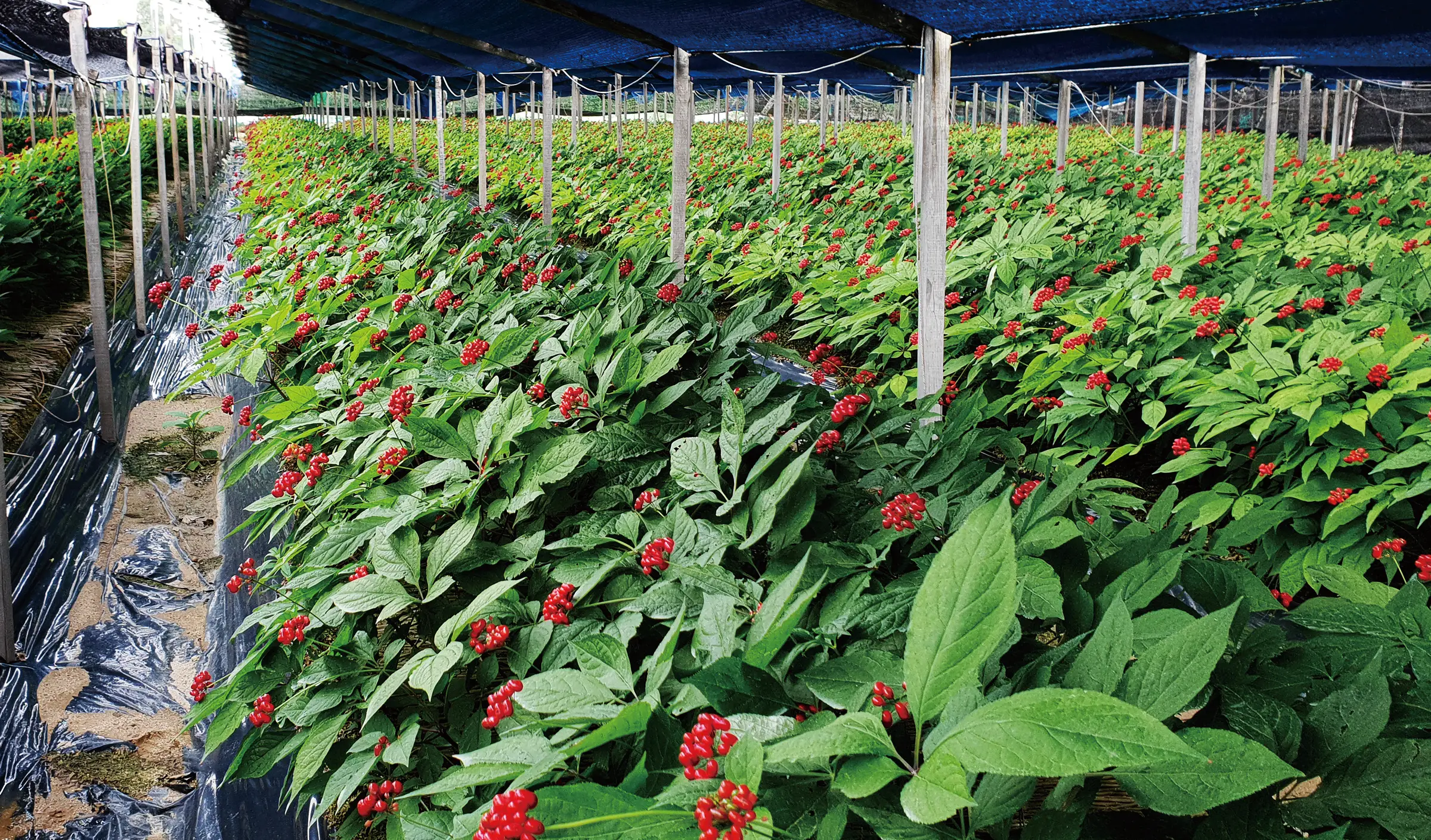
Six Years in One Field
A ginseng root holds its field for up to six years, under shade and through every summer, and then the land cannot grow ginseng again for a decade or more. That is why Korea's ginseng farms keep moving, and why the industry is now trying to make them stay.

From Green Bean to Iced Americano: How Korea’s Coffee Price Is Built
In 2025 the green coffee Korea imported cost half as much again, and café chains raised their Americanos. Public records can follow the bean from the exchange to the border and into the cup, and they show why the bean alone cannot explain a menu price.

The Orchard Moves North
Warm springs that wake trees too early, summers too hot for red fruit, and thousands of planting decisions are redrawing Korea's fruit map, but not in a straight line.