

Forest Crops & Processing
Sixty Days in the Wind: How Sangju Turns Persimmons into Gotgam
Korea's dried persimmons are made after the harvest, in open sheds and November wind. This year the crop is smaller, the forecast is warm and wet, and growers are deciding how much of the drying to leave to the weather.

 By Eli Navarro

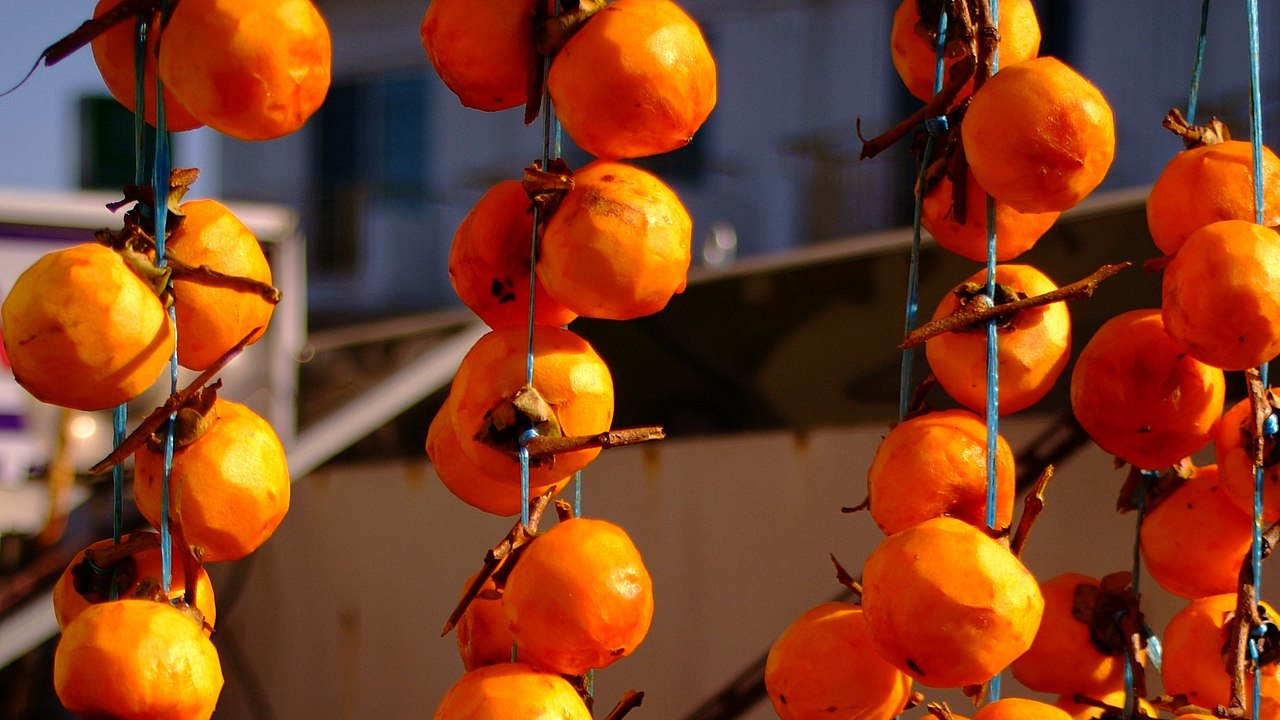
By the middle of November, Sangju's persimmon harvest is in. The fruit is an astringent variety, Sangju Dungsi, too puckering to eat fresh, and it does not wait long in the orchard. It is peeled before it softens, threaded on strings or clipped to hangers, and hung in open-sided drying sheds. The Rural Development Administration's guidance is short: pick the fruit fully ripe between mid-October and mid-November, peel it thin, and hang it in shade where the air moves.
For most fruit the season ends at harvest. For gotgam it starts there. A Sangju gotgam is made in the sixty or so days after the harvest, and the weather of those weeks decides what it is worth. Cool, dry air and a steady wind give a firm, sweet fruit with a white bloom; a warm, damp spell gives mould.
This autumn starts short. The Korea Rural Economic Institute, which surveys growers for the Forest Service, estimated last year's persimmon crop at about 130,000 tonnes, 21.3 percent below 2024, and in October expected this year's to fall another 14.1 percent, with Sangju down 16.7 percent after a summer of heat and drought. The Korea Meteorological Administration expects November to be warmer than normal and probably wetter. The drying weeks have arrived with less fruit and the kind of weather that, in 2015 and again in 2024, left mouldy or lower-grade gotgam.
A Sangju gotgam is made in the sixty or so days after the harvest, and the weather of those weeks decides what it is worth.
The season in four numbers
- Expected change in this year's persimmon crop
- −14.1%
- Sangju −16.7%; a survey of growers, 14–18 September (KREI forestry outlook, October 2026).
- Sangju households making gotgam, 2020
- 2,717
- Two-thirds of the 4,119 households growing astringent persimmons (Sangju City).
- Chance of a warmer-than-normal November
- 60%
- And 50% for more rain than normal, in the Korea Meteorological Administration's outlook of 23 October.
- Dried persimmon trade, January to September
- 62 t out, 244 t in
- Exports down 49.1% from 123 t a year earlier; imports down from 282 t (trade statistics, via KREI).
A forest crop with papers
On paper, the fruit is a forest product. Korea files astringent persimmons, the kind dried for gotgam, under the Forest Service, which surveys them beside the chestnuts of The Chestnut Hills; sweet persimmons, eaten fresh, belong to the agriculture ministry. Until last year the forestry statistics called the crop “astringent persimmon”. In 2025 they settled on the legal term, plain “persimmon”.
Sangju's version has papers of its own. The Forest Service registered Sangju gotgam as geographical indication No. 12 in June 2007, and in 2019 the agriculture ministry named the city's traditional gotgam farming the fifteenth of Korea's nationally important agricultural heritage systems. Much of it rests on the variety. Sangju Dungsi is round, dense and high in tannin, so it holds its shape as it dries, and growers still raise it the old way, grafted onto goyom, a wild relative, Nongmin Newspaper reported in February.
In 2020 the city counted 4,119 households growing astringent persimmons, of which 2,717 also made gotgam. Its agricultural technology centre now speaks of about 3,500 farms making some 19,000 tonnes of gotgam a year, the paper reported. Many buy much of their fruit: one Sangju producer grows a fifth of what it dries and buys the rest from local growers, the paper reported.
Sixty days, step by step
How a persimmon becomes gotgam under natural drying, from the Rural Development Administration's guidance, a 2004 study of traditional gotgam from Namjang and Bokryong in Sangju, and Sangju growers as reported. Days are counted from the start of drying and shift with the weather.
- Mid-Oct to mid-NovHarvest, fully ripe
Astringent persimmons are picked when fully ripe and peeled thin before they soften.
- Day 0Hung in the shade
On strings or hangers, in shade where the air moves.
- Days 7–14A second skin
Moisture loss slows as the surface hardens into a skin that does much to set the final quality.
- About day 21Sugar concentrates
Soluble solids rise from 18–27 to 40–50 °Brix.
- About day 25Semi-dried
At 45–55 percent moisture the fruit is banggeonsi, semi-dried gotgam.
- Sixty days and moreFully dried
The flesh turns from orange to dark brown and a white bloom rises on the surface.
- After dryingRested in the cold
Three to four days at refrigerator temperature.
- 6 Feb 2027Lunar New Year
The holiday that gotgam sales still crowd around.
When November turns warm
Sangju's drying weeks work because of where the city sits. Inland, its November and December air is fairly steady, Nongmin Newspaper explained: low temperatures stop the fruit losing its water all at once, stable humidity keeps mould down, and a gentle north-westerly keeps the air moving. Natural drying is not neglect, the paper added; the fruit is watched all winter.
When that weather fails, it shows. November 2015 averaged 10.1 °C across Korea, 2.5 °C above the 1981–2010 normal. Rain fell on 14.9 days, the most in records going back to 1973, the month brought 267 percent of its normal rain, and it had the least sunshine on that record. Seoul Shinmun reported that winter that 1,903 of 1,986 gotgam farms in five North Chungcheong cities and counties had damaged fruit, and that in Wanju, where mould was the first in more than thirty years, almost the whole batch was thrown away. Gotgam, as a processed product, fell outside crop disaster insurance, the paper noted.
November 2024 was the third-warmest on that record, 9.7 °C and 2.1 °C above the 1991–2020 normal, with more rain than usual. KREI later traced that season's poorer gotgam to the unusual temperatures of the drying weeks, together with weaker spending. In April 2025 a kilogram of top-grade domestic gotgam cost ₩26,141 in the forestry cooperatives' consumer-price survey, 19.2 percent less than the ₩32,333 of a year earlier, and the price has hardly moved since: about ₩25,500 a month from January to August this year. September's figure jumped to ₩38,452, which KREI puts down to Chuseok demand, fewer early sweet persimmons and a change in how the survey is taken.
On our reading, this year's forecast is the kind growers watch for. The Korea Meteorological Administration's outlook of 23 October gives November a 60 percent chance of being warmer than normal and a 50 percent chance of being wetter, and December a 50 percent chance of being warmer. Its reason is El Niño: in September the Pacific watch region ran further above normal than in any September on its record. KMA's own summary of November 2015 noted that the three wettest Novembers on its record to then, 1997, 2015 and 1982, all came in El Niño years. None of this makes a wet November certain; the agency puts the odds at one in two.
From the archive
What Sangju says about the weather
Only by drying slowly, all the way through, do you end up with good gotgam.
Climate change brings something unexpected every year, but the ways we have always worked and our experience carry us through.
Beyond the usual support, such as packaging and cold stores, we are also looking for more effective ways of drying naturally to prepare for climate change.

Shorter seasons, watched sheds
Growers are hedging. More of Sangju's fruit now goes out semi-dried, Nongmin Newspaper reported: banggeonsi suits buyers who like a softer fruit, and because it dries for less time it is less exposed to a bad spell. Other regions use machine drying, with heat and dehumidifiers that hold a room steady; most Sangju farms, the paper found, still dry both kinds naturally.
Between the two sits a shed that watches itself. A Sangju cooperative, Jayeon, fitted its natural drying shed with temperature and humidity sensors that open and close it, under a North Gyeongsang programme. The cooperative says its defect rate fell from 20 percent to 3 percent and its working period from 60 days to 15, so it ships more than a month earlier at prices at least 15 percent higher, Hankyung reported in December. Those are the cooperative's own figures; we found no independent measure.
Cold stores spread the risk over the year. In April, KREI found growers still holding 13.0 percent of the dried persimmon they had stored in December, and Sangju growers 25.0 percent. Trade does not take up the slack: in the first nine months of this year Korea exported 62 tonnes of dried persimmon and imported 244. Like the chillies of The Pepper Year, gotgam earns its value in the drying, and the drying is where the risk now sits.
“Natural drying is a bet on the November wind.”
What to watch
- The weekly outlook. KMA issues a one-month outlook every Thursday; the one of 29 October expects every week from 9 November to 6 December to be warmer than normal.
- KREI's December persimmon outlook, due on 4 December, with its estimate of the final crop.
- The price before Lunar New Year, on 6 February 2027. The forestry cooperatives' survey sat near ₩25,500 a kilogram from January to August.
- How much goes out semi-dried. A shorter drying season is one answer to the weather, and it changes what a Sangju gotgam is.
Sangju's craft was built on a November it could count on: cool, dry and windy. If that November becomes a coin toss, does the drying shed keep its open sides, or does gotgam become something made in a room?
Persimmons in the news
LiveRecent reporting on persimmons, gotgam and semi-dried persimmons from the Ag Digest news corpus.
- [Feature] Our Culture on a Plate ⑤ Sangju Dried Persimmons: Emulating Tradition and Creating the NewAgriculture, Fisheries & Livestock News (농수축산신문) · Nov 16, 2026
- Hansalim Launches Joint Food Care Campaign for Its 40th AnniversaryKorea Agricultural Policy Newspaper (한국농정신문) · Nov 10, 2026
- [Into the Field] Gwangyang Daebong Persimmon Farmers Cannot Smile Despite Bountiful Harvest… "Must Equip with Storage and Processing Facilities"Korea Farmers & Fishermen Newspaper (한국농어민신문) · Nov 6, 2026
- Field Evaluation Meeting for ‘Bonghwang’ Persimmon Ahead of Market Release; Attention Focused on New Shape and TextureRural Development Administration (농촌진흥청) · Nov 4, 2026
- Changwon Dokmoe Persimmon Farming: From Heritage to Sustainable AgricultureKorea Agricultural Policy Newspaper (한국농정신문) · Nov 1, 2026
- “The secret is close at hand”… Yeast fungus that controls persimmon anthracnose found ‘here’Nongmin Newspaper (농민신문) · Oct 29, 2026
More from the Magazine

Sweeter in Storage: How Korea's Autumn Sweet Potato Became a Winter Crop
Korea's sweet potatoes are out of the ground by late November, and in recent years Seoul's main wholesale market has traded more of them from February to June than at harvest. A few days in a hot curing room and months in a cool storehouse heal the roots, turn starch to sugar and have moved the market with them. What fills the storehouses is changing too: 44 percent of this year's planting was Korean-bred.

The Library That Lends Seeds
Seoul Botanic Park lends about a gram of seed to anyone who signs its ledger, and has posted a new list every month for five years. We read all 61. They show a careful shelf of old Korean varieties, a calendar that slips in winter, and a library that grows whenever a borrower brings seed back.

Yuja, Not Yuzu: The Jar Korea Fills and the Name It Lost
Every November the south coast picks a small, knobbly citrus that is almost all peel, and most of it goes into jars with sugar. Korea shipped more than 20,000 tonnes of those jars last year, and the United States overtook China as the biggest buyer. Abroad, the jar is often sold as citron tea or yuzu tea.