Korea Ag Digest logoKorea Ag Digest logo

Korea Ag Digest

Curated Korean Agriculture News
DigestMagazine

Menu

DigestMagazine

Data

MarketPrice signals for livestock, eggs and farm productsWeatherKMA warnings, soil, observations and crop-risk recordsIntelligenceCrop-risk, import grain and smart-farming signals from our coverage

Desks

CoffeePremiumArabica and Robusta benchmarks, FX signals, café newsBeer & SpiritsPremiumBrewing and distilling inputs, Korean trade, industry news

Free calculators

Coffee landed costBrewery batch costWhisky maturation cost
Buying for a café, brewery or distillery?Request a demo
Korea Ag Digest logoKorea Ag Digest logo

Built to support open discussion and long-term understanding of Korean agriculture. Not affiliated with any publisher.

Explore

MagazineMarketIntelligence

Intelligence

Crop weather mapsWeather & crop riskImport grainSmart farming

Company

AboutTerms of ServicePrivacy PolicyVersion History

Account

Log InSign UpHelp & feedbackCommunity
The Magazine

Korean agriculture, in depth

Origins, markets, and the people — long-form features, mapped and sourced.

Read the Magazine

Resources

EkapepiaCropBioKREIAT Corp
Korea Agriculture Technology Promotion AgencyFarmer Safety 365RDA / Young FarmersPublic Data Portal for Agriculture, Food and Rural AffairsNetwork for Agri-Forest-Food-Tech Information
GitHubShmaplex GitHubCSL GitHubvv2026.08.15

⚠️ Korea Ag Digest is an independent news aggregator and is not affiliated with any of the news outlets referenced. Content is provided without warranty and does not constitute professional advice.

© 2026 Korea Ag Digest. All rights reserved.

Back to Magazine

Fields & Seasons

Korea's Garlic Belt: Where the Pungency Comes From

Two garlics — a cold-hardy northern type and a mild-wintered southern one — split the peninsula between them, and the season that carries an autumn clove to a June bulb sets the price on the shelf.

By Mi-kyung Han
Published Jul 12, 2026·6 min read
Freshly harvested garlic bulbs spread out to dry on a mat in front of a tiled-roof farmhouse
Just-lifted garlic curing in the sun at a farmhouse in Goheung-gun, South Jeolla — the June end of the garlic year. · Credit: Steve46814, CC BY-SA 3.0, via Wikimedia Commons

Garlic (마늘) sits at the base of almost every Korean dish — alongside green onion, ginger and chili, it is one of the aromatics a Korean kitchen cannot do without. Unlike most of what fills the pot, the fresh bulb on the shelf is overwhelmingly homegrown. But the crop is not spread evenly across the country: a belt of southern-coast and inland counties does most of the growing, and their two very different kinds of garlic — and the weather over one winter — set the tone for the national price.

This feature maps where Korea's garlic comes from, explains the split between cold-type and warm-type garlic, walks the season that turns an autumn clove into a June bulb, and reads the market signal behind the price — with a live link to prices for every commodity on the market data page.

Garlic at a glance

Planting
Sep – Oct
Cloves go in before the first frost.
Scape harvest
May
Flower stalks (마늘종) are pulled first.
Bulb harvest
Jun
Then lift, dry and cure the bulbs.
Two types
Cold · Warm
한지형 north/inland; 난지형 warm south.
Leading regions
Gyeongnam · Jeonnam
With Uiseong (경북) the cold-type icon.

Two garlics: cold-type and warm-type

The single most important thing to know about Korean garlic is that there are two of it. Growers and the Rural Development Administration (RDA) sort domestic garlic into hanjihyeong (한지형), the cold-type, and nanjihyeong (난지형), the warm-type — and the split is really about how a clove spends the winter.

  • Cold-type (한지형) — grown in colder inland and northern-leaning counties such as Uiseong (의성) in North Gyeongsang, Danyang (단양) in North Chungcheong, and Seosan and Taean (서산·태안) on the west coast. The clove needs a long, real cold spell, so it sits dormant through winter and only sends up a shoot in spring. It is the classic yukjjok-maneul (육쪽마늘), the tight six-clove bulb prized for pungency and long storage — but it yields less and comes in a little later.
  • Warm-type (난지형) — grown along the mild southern coast and islands: Namhae and Changnyeong (남해·창녕) in South Gyeongsang, Goheung, Muan and Sinan (고흥·무안·신안) in South Jeolla, Gochang (고창) in North Jeolla, and Jeju. With no hard freeze to wait out, the clove sprouts in autumn, grows through a soft winter, and is harvested earliest. Bulbs are larger with more cloves; the flavor is rounder and milder, and it does not keep as long.

That is where the pungency story lives. The cold-type bulb, forced to wait out a hard winter, is the one Korean cooks reach for when they want bite — a widely-held view among growers and buyers that a colder season concentrates a garlic's sharpness. The warm south grows the volume; the cold north grows the reputation.

The type names describe cold requirement and habit, not a strict provincial border: a few counties grow both, and cultivar choice (Namdo, Daeseo and others) matters too. Treat the regional examples here as the well-known centers of each type, not an exhaustive list.

Where garlic is grown

Relative garlic production by province. Warmer-shaded regions carry more of the crop. The warm-type south — South Gyeongsang (Changnyeong, Namhae, Hapcheon) and South Jeolla (Goheung, Muan, Sinan, Haenam) — leads on volume; North Gyeongsang's Uiseong anchors the cold-type north, with Chungcheong's Seosan/Taean and Danyang alongside it.

Map of Relative production across South Korean provincesGyeonggiGangwonChungbukChungnamGyeongbukJeonbukGwangjuGyeongnamJeonnamJeju

Select a region to focus it.

Legend (index)
  • 6–25
  • 25–44
  • 44–62
  • 62–81
  • 81–100
Relative production by province
RegionRelative production (index)
Gyeonggi9 index
Gangwon6 index
Chungbuk22 index
Chungnam46 index
Gyeongbuk60 index
Jeonbuk33 index
GwangjuNo data
Gyeongnam100 index
Jeonnam94 index
Jeju38 index

Relative index (0–100) summarizing the documented production ranking, not KOSIS/MAFRA tonnage or an estimate of absolute output. It should only be used to compare the broad regional pattern shown here. No private farm coordinates are used; only province-level aggregation.

Source: Illustrative relative index — see methodologyAs of 2026

The regions, county by county

A handful of names come up again and again on the sack and the price board. In the cold-type north, Uiseong (의성) in North Gyeongsang is the byword for 육쪽마늘 — the county leans on its garlic hard enough to have built a landmark garlic tower — while Danyang (단양) grows a prized highland cold-type and Seosan and Taean (서산·태안) carry the west-coast six-clove reputation.

In the warm-type south, Namhae and Changnyeong (남해·창녕) in South Gyeongsang and Goheung, Muan and Sinan (고흥·무안·신안) in South Jeolla are the volume country, with Gochang (고창) in North Jeolla and warm, early Jeju filling out the map. The field, harvest and curing photographs in this feature were taken in Goheung, one of the warm-type heartlands — and the storage-rack image is from Uiseong, on the cold-type side.
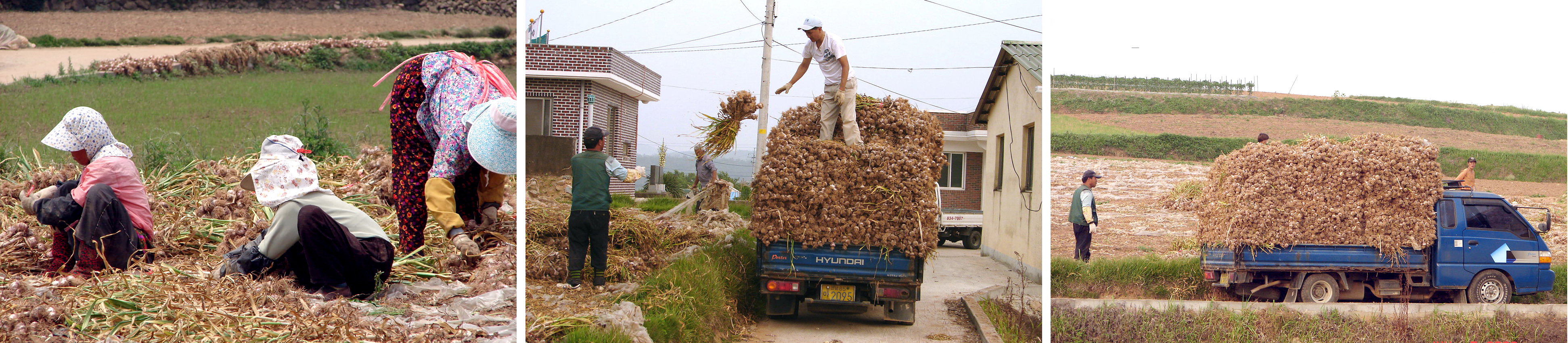
A panorama of the garlic harvest: workers lifting bulbs in the field, a truck being loaded, and a laden truck driving the crop away
One June morning in Goheung, South Jeolla: from the field to a loaded one-ton truck. Harvest is the year's tightest labor window. · Credit: Steve46814, CC BY-SA 3.0, via Wikimedia Commons · Rights: CC BY-SA 3.0 — see docs/magazine-image-rights.md

One garlic year

The season that turns an autumn clove into a summer bulb — and, in between, a scape.

  1. Sep – Oct
    Planting

    Individual cloves (쪽마늘) are sown so roots establish before winter; warm-type fields sprout in autumn, cold-type stays dormant.

  2. Nov – Feb
    Overwintering

    Plants sit under mulch and cold. A hard freeze can thin the stand and is a real risk for early-sprouted warm-type fields.

  3. May
    Scape harvest (마늘종)

    Flower stalks are pulled so the plant puts its energy into the bulb; the scapes are sold and eaten as a vegetable in their own right.

  4. Jun
    Bulb harvest (통마늘)

    Bulbs are lifted — warm-type south first, cold-type north a little later — then dried and cured for storage.

  5. Jul – onward
    Cure, store, sell

    Cured garlic moves to wholesale and retail and into cold storage; the cold-type keeps longest and carries the shelf toward the next crop.

Source: RDA growing calendar (general)As of 2026

From bulb to kitchen: peeled, minced, and black

Few Korean shoppers still peel a whole head clove by clove. The everyday format is kkanmaneul (깐마늘), pre-peeled garlic sold by the bag, and dajin-maneul (다진마늘), the ready-minced paste that goes straight into the pan. The peeled form is exactly what the market series below tracks.

At the premium end sits heuk-maneul (흑마늘, black garlic) — whole bulbs held warm and humid for weeks until the cloves turn soft, dark and sweet-savory. Marketed as a health food, it has given garlic-growing regions a value-added product that outlasts the fresh season. Underneath all of it is the same quiet engineering that defines the apple shelf: storage. Cured cold-type garlic, kept cool and dry, is what lets Korea eat domestic garlic long after the June harvest — and, as with apples, the tightest prices tend to come late in the storage year.

The retail garlic signal

Live

National-average retail price for peeled domestic garlic (KAMIS item 깐마늘(국산), sold 원/kg). When live KAMIS data is available it shows here automatically; otherwise this is an editorially pinned, clearly-labeled snapshot. Prices typically ease at the June harvest and firm through the storage year until the next crop.

Latest
10,888
Garlic KRW/kg
Weekly change
-585(-5.1%)
Range
6,360–13,764
As of Sep 16, 2026
View full market data

Domestic bulbs, imported pressure

The fresh bulb on the shelf is a Korean bulb, but garlic is one of the most import-exposed crops in the basket — and one of the most politically sensitive. Strict quarantine on fresh whole bulbs means most imported garlic arrives in other forms: frozen, peeled, or preserved product, overwhelmingly from China, which competes hard on price against domestic peeled garlic.

Trade policy is the pressure valve. Garlic sits behind a high out-of-quota tariff with a WTO tariff-rate quota (TRQ); when a short domestic crop sends prices spiking, the government can release additional TRQ imports and draw on purchase-and-stockpile (수매·비축) programs to cool the market — and, in a good year, buy up surplus to keep farm-gate prices from collapsing.

Garlic's price swings have a long political tail: the 2000 Korea–China dispute over Korean safeguard tariffs on Chinese garlic (the so-called "garlic war") is the textbook case of how sensitive this one bulb can be. Recurring 마늘 파동 (garlic price shocks) still make national news whenever a bad winter thins the crop.

“You can taste the winter in a bulb of garlic — a cold season concentrates the pungency.”
— A sentiment common among cold-type garlic growers

From field to storage

A tied bundle of long, curling green garlic scapes
Garlic scapes (마늘종) — the flower stalks pulled in May, sold and cooked as a vegetable. Illustrative; not Korea-specific. · Credit: Suginami (CC0) · Rights: CC0 — see docs/magazine-image-rights.md
Workers loading a small blue truck piled high with just-harvested garlic beside a field
The June bulb harvest moving out of a Goheung field by the truckload. · Credit: Steve46814, CC BY-SA 3.0, via Wikimedia Commons · Rights: CC BY-SA 3.0 — see docs/magazine-image-rights.md
Bundles of harvested garlic leaning to dry against a traditional mud-walled farmhouse, with a black-mulched field to the side
Bundled garlic curing against a farmhouse; note the black-mulched rows at right. · Credit: Steve46814, CC BY-SA 3.0, via Wikimedia Commons · Rights: CC BY-SA 3.0 — see docs/magazine-image-rights.md
Bunches of garlic hung on a large timber rack under a roof to dry and store
Cold-type garlic hung to dry and store in Changgil-ri, Uiseong County — the storage that carries the shelf toward next year. · Credit: Robert (Picasa), CC BY-SA 3.0, via Wikimedia Commons · Rights: CC BY-SA 3.0 — see docs/magazine-image-rights.md

Related coverage

Live

Recent ingested articles that mention garlic, pulled live from the news corpus.

  • Garlic and Onion Producers' Associations: “Substantially Reflect Farmers’ Voices in Supply Management and Price Stabilization Systems”Korea Agricultural Policy Newspaper (한국농정신문) · Sep 15, 2026
  • Garlic and Onion Producers' Associations: “New Agricultural Products Marketing Act Must Become a Substantial Price Safety Net”Korea Agriculture Newspaper (한국농업신문) · Sep 15, 2026
  • [Reporter's Notebook: Rice-jeok Rice-jeok] The Value of Kimchi Hidden Behind Free Side DishesKorea Agriculture Newspaper (한국농업신문) · Sep 15, 2026
  • Control garlic and onion weeds before they sproutKorea Agriculture Newspaper (한국농업신문) · Sep 15, 2026
  • The items subject to the Agricultural Product Price Stabilization System in 2026 are ‘garlic and onions’Korea Agricultural Policy Newspaper (한국농정신문) · Sep 10, 2026
More news
Sources & methodology

Market figures come only from KAMIS (aT) national-average retail data for peeled domestic garlic (깐마늘(국산), 원/kg); the pinned snapshot is an illustrative fallback, clearly labeled, not a sourced price. The regional map intentionally uses a relative index to show the documented production pattern and must not be read as exact KOSIS/MAFRA tonnage. The cold-type/warm-type (한지형/난지형) distinction, the growing calendar, the peeled/minced/black-garlic forms, and the import/TRQ/stockpile dynamics (including the 2000 Korea–China garlic dispute) are drawn from public reporting, the RDA growing calendar, and the agriculture-market-research skill; no tonnage or price is invented and no private individuals or farms are named. Images are license-verified: the field, harvest and curing photographs are Korea-specific (Goheung-gun and Uiseong County) under CC BY-SA 3.0 with attribution; the garlic-scape photo is CC0. Each source, author, license and clearance status is recorded in docs/magazine-image-rights.md.

Sources:
  • KAMIS (aT) price data
  • KOSIS / Statistics Korea
  • Rural Development Administration (RDA)
  • MAFRA (Ministry of Agriculture, Food and Rural Affairs)

More from the Magazine

A Korean pear orchard in summer, with young fruit wrapped in white paper bags under a green canopy
Climate & Orchards

The Orchard Moves North

Warm springs that wake trees too early, summers too hot for red fruit, and thousands of planting decisions are redrawing Korea's fruit map, but not in a straight line.

Sep 17, 2026·8 min read
Tall walls of green hop bines climbing strings between wooden poles in a hop yard under a grey sky
Hops & Brewing

Can Korea Grow Its Own Hops?

Korea grew hops once, then imported nearly all of them. Now a handful of farms are planting again while imports fall by half. What would make a Korean hop something brewers buy twice?

Sep 17, 2026·8 min read
A dense layer of dried Korean red chili peppers
Peppers & Seasonality

The Pepper Year: From Green Fruit to Korea's Red Pantry

One plant moves through two markets and a dangerous summer: fresh green pepper, ripe red fruit, dried pods, powder, and the long work of protecting color and flavor.

Jul 13, 2026·6 min read